Design of slender bridge foundations
Motivation
About this use case
This use case demonstrates how Caliber can be used to automate a process that was inefficient due to manual exchange of data between disciplines.
Bridge design involves collaboration between a range of disciplines to solve a range of scopes. One of these scopes is the foundation design.
Here the geotechnical discipline collaborates with the structural discipline to come up with a design that has a sufficient margin against failure of both soil, piles and foundation structure, as well as providing sufficient stiffness to the bridge superstructure.
Whereas the geotechnical discipline relies on input from other disciplines to get the location and design the layout of the pile groups, the structural discipline relies on the soil stiffness calculated by the geotechnical discipline to be able to define realistic support conditions in their finite element analyses. Data is therefore transferred back and forth between the disciplines.
If the soil conditions are poor, and the superstructure is slender, and thereby sensitive to second order effects, several iterations are usually necessary to come up with a feasible global concept.
The traditional collaboration and workflow to go from foundation layout to complete finite element analyses of the foundation has the following main challenges:
Manual execution of computer programs by both disciplines.
Manual copying of pile calculation results to spreadsheets for calculating soil stiffnesses.
Data exchange between the disciplines through e-mail.
The manual processing of analysis results in spreadsheets is convenient if the scope is limited, however with many axes along the bridge, several estimates of soil properties, and possible updates throughout the project, it is easy to loose track of versions.
Solution
To facilitate for smoother collaboration between the geotechnical and structural disciplines, workflows powered by Caliber and Python were defined. The data exchange was handled through the Speckle server.
The following actions were taken:
Create Python interfaces for running the computer programs in batch mode. Automate writing appendics to the analysis reports. Collect functions in Caliber Workflows. Set up a dashboard for viewing the soil stiffnesses available on the Speckle server.
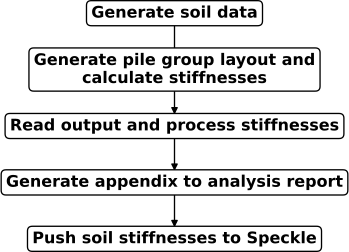
The main geotechnical workflow is shown below.
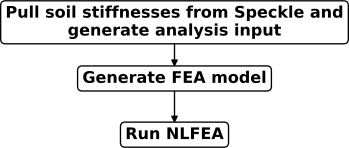
The main structural workflow for running a non-linear finite element analysis (NLFEA) of the foundation structure is shown below. Note that some utility tasks, e.g. for cleaning the workspace, and tasks for defining the necessary reinforcement amounts, are omitted for brevity.
Benefits
Some of the benefits from adopting a workflow powered by Python and Caliber are:
Analysis time saving in the order of one man-week, allowing for exploring design alternatives and improving the overall understanding of the global structural and geotechnical behaviour.
Full backlog of soil stiffnesses stored on the Speckle server with visualizations in a dashboard.
Automated reporting of analysis results.